How Many Yards of Dirt Are in a Dump Truck Load?
A standard tandem-axle dump truck holds about 10 to 16 cubic yards of dirt and legally carries roughly 12 to 14 tons of it. That is the number most people are looking for. The longer answer is more useful: the yard count changes with the truck, the material and even the weather, and knowing why puts you ahead of most people ordering dirt.
Trucks are half our business at RLS. Our dump truck hauling fleet moves dirt out of our own pits every working day, so these are numbers we live by.
Capacity by truck type
| Truck type | Cubic yards | Typical payload |
|---|---|---|
| Single-axle (small) | 5 to 8 yd | 5 to 10 tons |
| Tandem (10-wheeler) | 10 to 16 yd, ~12 typical | 12 to 14 tons |
| Tri-axle / quad | 14 to 20 yd | 16 to 26 tons |
| End dump (semi) | ~18 yd | ~22 tons |
| Super dump | 19 to 26 yd | 19 to 26 tons |
| Belly dump | ~22 yd | ~24 tons |
| Side dump | 21 to 26 yd | 22 to 26 tons |
| Pickup with trailer | 1 to 2 yd | not in the same sport |
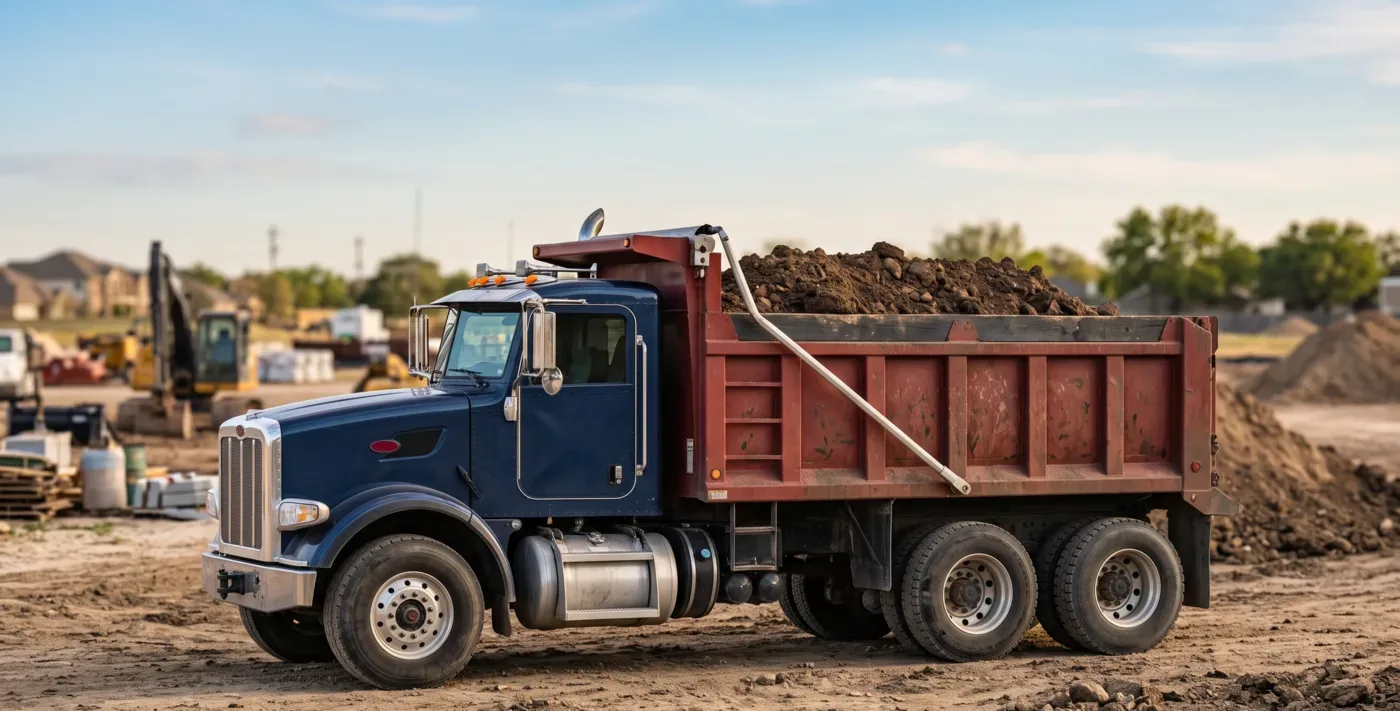
Our fleet is tandem trucks, the workhorse class for Gulf Coast dirt: big enough to move real volume, nimble enough for ranch gates and residential streets.
What a yard of dirt weighs
Everything else here hangs on one range: a cubic yard of dirt weighs roughly 2,000 to 2,700 pounds, about 1 to 1.35 tons. Texas supplier data breaks it down by material:
| Material | Pounds per cubic yard |
|---|---|
| Screened topsoil | 2,000 to 2,400 |
| Fill dirt | 2,300 to 2,700 |
| Select fill | 2,400 to 2,800 |
| Sand | 2,600 to 3,000 |
| Road base | 2,700 to 3,100 |
Moisture is the swing factor. Wet clay can push past 3,000 pounds per yard, which matters more than it sounds, as the next section shows.
Why the bed is rarely full: weight limits win
Legal weight, not bed volume, is what actually fills a dump truck. Federal and Texas rules cap a standard rig at 80,000 pounds gross with 34,000 pounds on a tandem axle group, and with dense material the truck reaches legal weight before the bed looks full.
Run the math on a 12-yard tandem rated around 14 tons, and the yard count moves with the material. This is arithmetic, not a quote:
| Material | Yards the tandem actually carries |
|---|---|
| Dry topsoil (2,000 lb/yd) | 12 yd, the bed fills first |
| Fill dirt, dry (2,300 lb/yd) | ~12 yd |
| Select fill (2,400 lb/yd) | ~11.7 yd, weight first |
| Fill dirt, wet (2,700 lb/yd) | ~10.4 yd, weight first |
| Sand (3,000 lb/yd) | ~9.3 yd, weight first |
The takeaway is genuinely useful: the same truck delivers about 12 yards of dry dirt and about 10 of wet, so rain changes how many loads your job takes. It is also why honest haulers quote by the load or the ton rather than promising a fixed yard count year-round.
Yards, tons and the conversions people ask for
All arithmetic, using the ranges above:
- One ton of dirt is about 0.75 to 1 cubic yard.
- 10 yards of dirt weighs about 11.5 to 13.5 tons.
- 20 tons of fill dirt is about 15 to 17 cubic yards.
- Volume formula for any project: length times width times depth, all in feet, divided by 27 equals cubic yards.
One worked example, labeled as math: a 60 by 40 foot pad footprint raised 2 feet is 178 in-place yards, call it about 215 loose yards after compaction allowance, which is roughly 18 tandem loads. A full engineered pad with oversize and slopes runs more, and our house pad cost guide walks that complete version.
What this means when you order
For a few yards, a landscape yard and a small truck make sense. Once a project counts in tens or hundreds of loads, the economics flip to fleet work: trucks cycling on a schedule, loads sized to legal weight, and material sourced close so the cycle time stays short. That combination is our normal day. The dirt comes off our own select fill and dirt pits in southeast Fort Bend County, the tandems are ours, and on deadline jobs they run around the clock.
Tell us the volume or the footprint and we will do the load math with you. Call (281) 750-6510, and if you only have dimensions, that is enough to start.