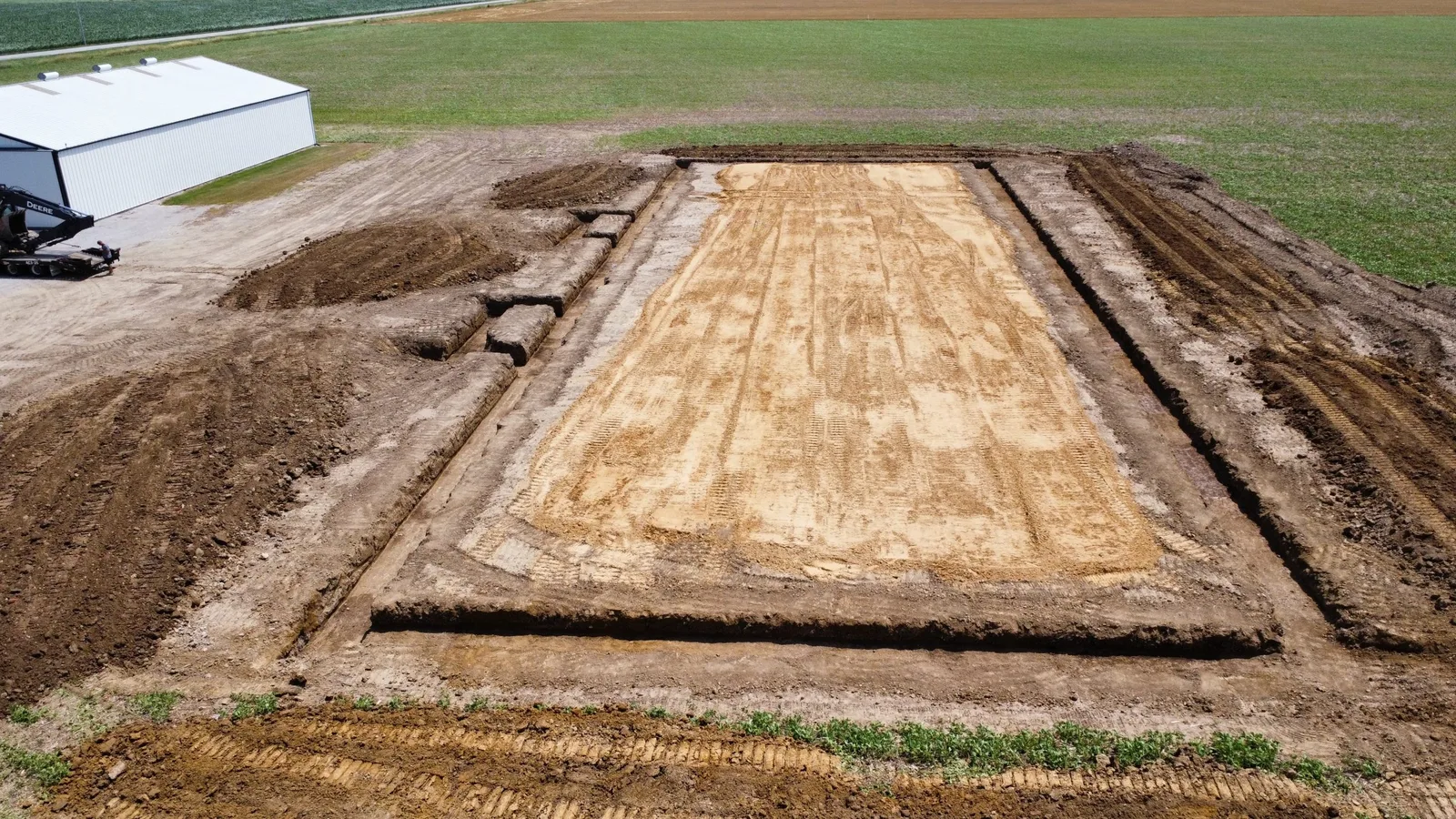
How Much Does Land Grading and Leveling Cost?
Land grading costs run on two entirely different scales, and most cost guides quietly mix them. Small residential work prices per square foot: roughly $0.40 to $1.00 for finish grading and $1 to $2 for rough grading, which is how a typical yard regrade lands between $1,000 and $5,000. Acreage prices by machine time and dirt volume, and real multi-acre grading commonly runs closer to $1,000 to $5,000 per acre, not the five-figure per-acre numbers the calculators spit out.
Grading is the core of our dirt work and grading service, so here is the honest version of the math, including the error to watch for.
The per-acre number most cost guides get wrong
Search “cost to level land per acre” and you will meet figures like $17,400 to $44,600 per acre, with one guide averaging $30,000. Those numbers are residential per-square-foot rates multiplied by 43,560. The guides even admit it: most projects they price are a quarter acre or less.
Nobody grades forty acres at backyard rates. Acreage work runs big machines across open ground, where the cost per square foot collapses. Field-scale leveling, pasture regrades and drainage shaping quote off machine hours and yards of dirt moved. When an acreage quote comes in at a twentieth of the internet’s number, that is not a suspiciously low bid. That is the actual market.
What actually drives a grading price
Four inputs set nearly every grading quote:
| Driver | Why it moves the number |
|---|---|
| Cut-and-fill volume | Moving 200 yards is a morning; moving 5,000 is a project |
| Imported or exported dirt | Balanced sites are cheapest; hauling dirt in or out adds trucking |
| Drainage work | Swales, ditches and outfalls are shaped, not sprinkled |
| Site conditions | Wet clay, brush in the way, tight access all add hours |
The dirt-balance line matters most around here. When a site needs fill to reach grade, the material and its trucking join the bill, and that is where our position is different: the select fill and dirt comes off our own pits on our own trucks, so the import side of a grading job stays in one quote instead of three.
For context on the machine economics: residential-scale outfits with skid steers bill roughly $100 to $300 per hour. Our equipment class is built for the acreage end, where production per hour, not the hourly rate, decides the total.
Rough grade, finish grade, and which one you need
Rough grading is the structural pass: cutting highs, filling lows, establishing the fall that moves water. Finish grading is the cosmetic top-few-inches pass that gets ground ready for sod, seed or gravel. Projects that skip the rough pass and pay for finish work on badly shaped ground buy the same problem twice. On acreage, most of the value is in the rough pass.
The flat-ground rule: fall needs somewhere to fall to
Here is the Gulf Coast wrinkle that generic grading articles miss. Around Fort Bend, Brazoria and Wharton Counties the ground barely slopes, and the native gumbo clay barely absorbs. Grading creates fall, but fall without an outlet just relocates the puddle to the neighbor’s fence line, or right back to yours.
Every grading plan on flat prairie starts from the outlet and works backward: a roadside ditch, a swale, a detention area, a pond. Sometimes the honest answer is that the low corner wants to become a pond rather than fight one. When drainage is the real complaint behind a grading call, we design for where the water ends up, not just where it stops sitting.
When to grade
When the ground is dry. Wet clay smears under tracks, ruts instead of cutting, and will not compact at the moisture it is carrying. Dry-season windows produce better ground for less money, and a contractor willing to wait a week for the site to dry is protecting your dirt, not stalling.
Getting a real number
Use the ranges here to sanity-check quotes: yard-scale work in the low thousands, acreage work priced per acre in the low-to-mid thousands depending on volume and drainage, and imported dirt as its own line. The firm number comes from the site and the water.
If the ground that needs shaping sits southwest of Houston, call (281) 750-6510. We will read the fall, find the outlet and quote the grade with the dirt and trucking included.