Serving Richmond, TX
Dirt work in Richmond, Texas is usually about water. The ground out here is flat, and Fort Bend clay holds whatever falls on it. So the water sits. It sits in the low corner of a pasture, around a barn pad and beside a washing driveway. Grading is how you fix that. We cut slope into the ground so water leaves on its own. It has to reach a ditch or a culvert that actually drains. We work with large excavators and dozer-class equipment, backed by tandem dump trucks. When a low spot needs raising, the fill comes off our own pits south of town.
Grading is the step nobody notices until it is wrong. A pad set an inch low takes water. A driveway with no crown holds it. A pasture graded flat instead of falling stays soft for weeks. We shoot elevations and set the fall, then check it as the work goes. On Richmond acreage that means moving a lot of dirt for a small change in grade. Small grade changes take big volume out here. Our minimum project is about $10,000, which fits acreage regrades and building sites.
Tell us about your project — we’ll get right back to you.
Richmond sits low next to the Brazos, and the county is close to flat. Fall on a typical property here gets measured in inches over a hundred feet. That is not much to work with. Clay soil takes water slowly and gives it back slowly. Put those together and you get standing water after every good rain. Fort Bend County drainage criteria treat clay ground as high runoff for that reason. Water does not soak in here. It has to be sent somewhere, and slope is what sends it. Every grading job in Richmond starts from that fact.
The first thing we do on a Richmond grading job is find the outfall. Water has to end up in a ditch, a culvert or a drainage way. Cutting a low spot without an outfall just moves the puddle. Once we know where it goes, we set grades back from there. That may mean a swale across a pasture or a raised pad with fall on all sides. On acreage it often means both. We check grade with instruments instead of by eye. At this little fall, a quarter inch shows up.
A regrade is a full reset of how a property drains. We strip the topsoil and stack it, cut the high ground and fill the low ground. Then the whole surface gets shaped to fall. Topsoil goes back on top so grass will grow. On a Richmond acreage tract that can be tens of thousands of yards moved. It is a big job. It is also the fix when a whole property drains wrong. Patching one wet corner usually pushes the problem to the next corner. We would rather price the whole surface than chase spots.
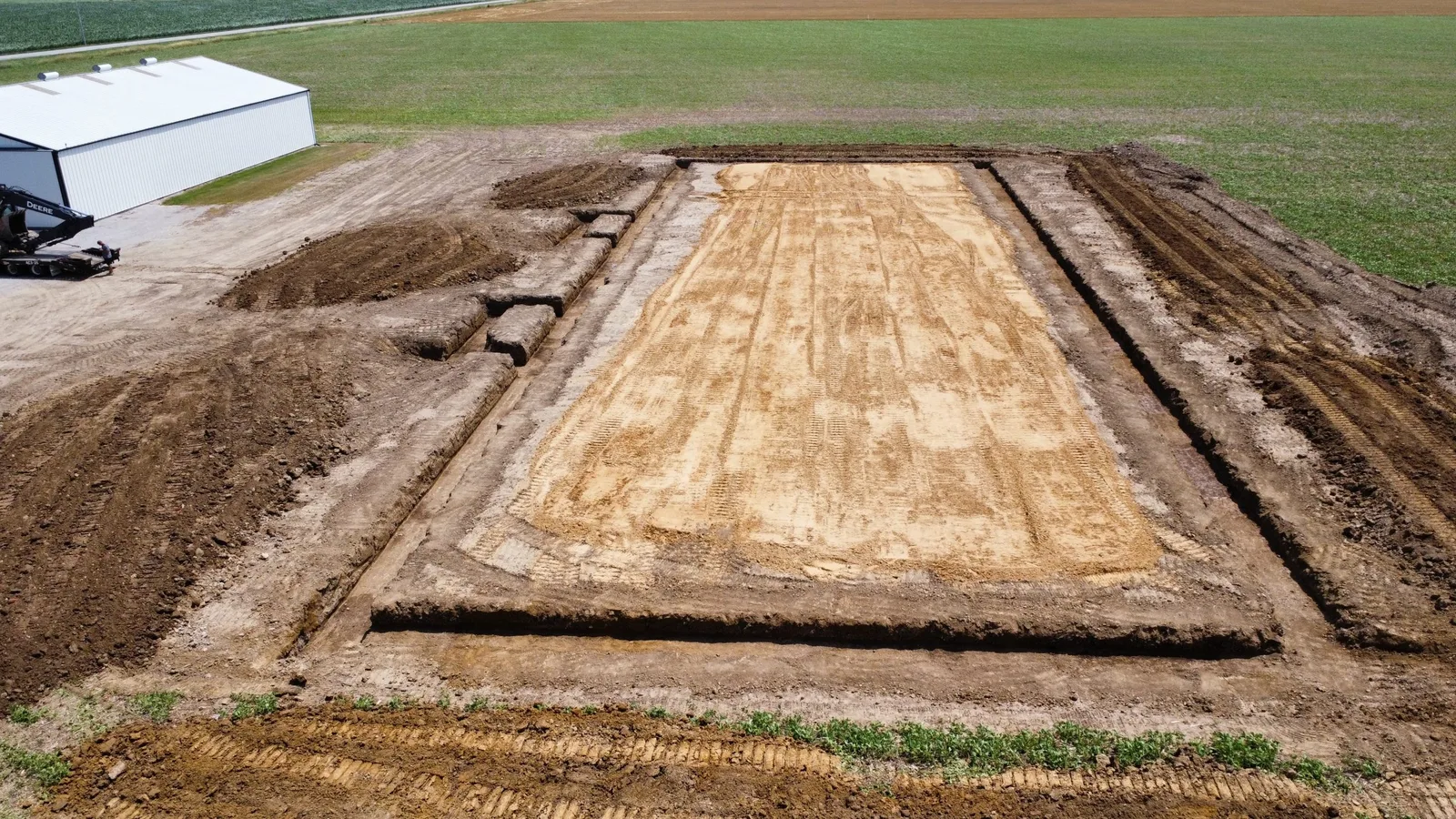
Barn and shop pads get the same treatment on a smaller footprint. The pad has to sit above the ground around it, with fall running away on every side. We bring select fill from our pits, place it in lifts and compact each one. Then the finish grade gets set to the elevation the builder wants. Around Richmond the common mistake is a pad built at grade instead of above it. That building takes water every spring. Fixing it later costs more than building it high the first time. Height is cheap while the trucks are already there.
A lot of Richmond dirt work is a ditch or a swale in the right place. A wide, shallow swale across pasture moves more water than a narrow trench. It also mows over, so the pasture stays usable. We cut swales to a steady fall so nothing ponds along the way. Culverts under drives get set at the right elevation and sized for the water. A culvert an inch too high backs water up behind it. On acreage the whole system has to work from the far corner to the road ditch.
Driveways and ranch roads are grading jobs before they are surfacing jobs. The subgrade has to be crowned and compacted. Skip that and the base will pump and rut. We build the crown so water runs to the shoulder instead of the wheel tracks. Base rock goes on after that and gets compacted in lifts. On the FM 762 and Crabb side, roads cross wet ground. There we raise the road above the field. That takes more dirt up front and it keeps the road usable in February. The dirt comes off our pits, so the material and the work stay together.

Free, no-obligation estimates throughout Fort Bend County.
(281) 750-6510From the first look at the ground to the last pass of the grade, here is exactly how it goes.
We meet you at the property and read the job off the ground itself: what is growing, where water sits, how trucks and excavators get in. Big dirt work prices off what is really out there.
You get a free quote with a real number and a real plan: what gets dug or cleared, how many loads move, where the dirt comes from or goes. It holds unless the scope changes.
The equipment shows up when we said. Excavators dig, trucks run in rotation, and on deadline jobs we run shifts around the clock until the volume is moved.
The last pass matters as much as the first load. Pads compacted and holding elevation, ponds shaped and ready for water, ground graded so it drains. We look at the finished work with you before we leave.
What Richmond property owners ask us most about dirt work & grading. Don't see yours? Give us a call — we're happy to help.
A pond you have been putting off, a pad that needs building, land that needs clearing, or a job that needs truckloads of select fill? Call or send the form. Tell us where the property is and what you want the land to do, and we will set a time to come look at it.
Tell us about your project — we’ll get right back to you.